
Looking for an alternative to an implant? Here are bridges and dentures.
When a tooth goes, there are three ways to replace it: an implant, a fixed bridge on the teeth beside the gap, or a removable denture, partial or full. Each one suits some cases and not others; here you see the three side by side, and the examination decides which one suits your mouth.
Hours: Sat–Wed 10–6 · Thu 10–4 · Fri closed
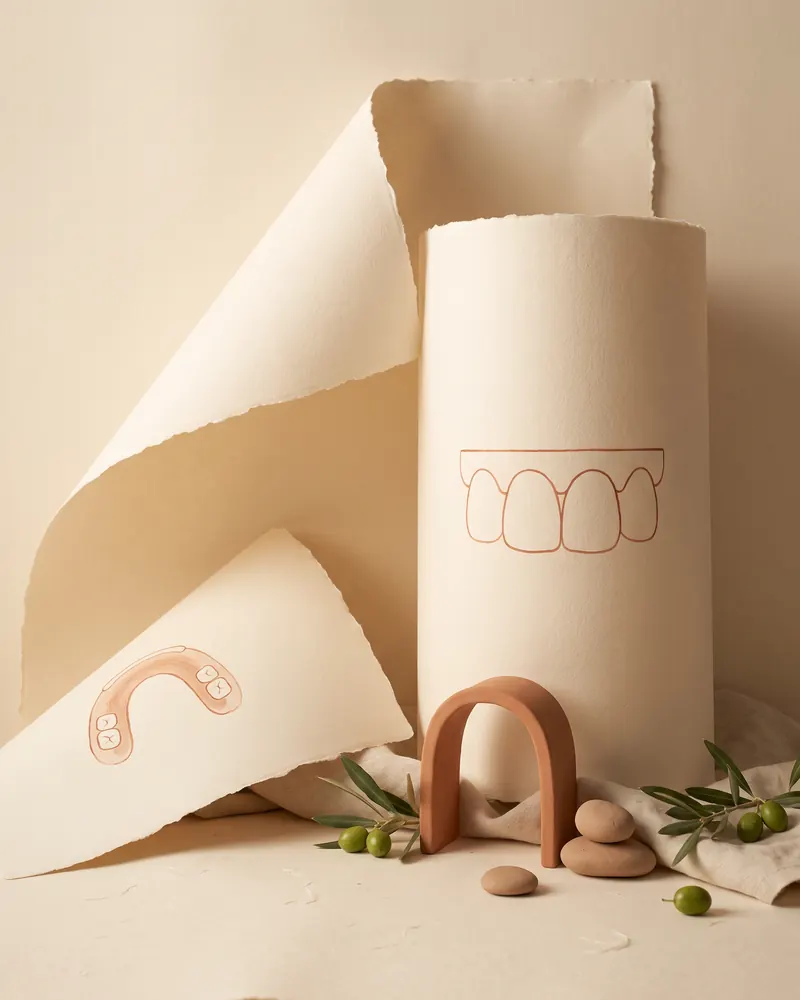
What bridges and dentures are, and who they are for
Most people who land here come with one question: is there anything other than an implant? The answer is yes, two things: a fixed bridge, and a denture that comes out. The words blur, though: a partial denture is also called a removable bridge or a plate, and in Amman you may hear one Arabic word, tarkeeba, used for all of them. So here is what each one is.
Who this page is for
- You have lost one tooth, to an extraction, a knock, or decay that was caught too late, and you want to know what there is besides an implant.
- You are missing a few teeth, side by side or scattered.
- You have no teeth left in one jaw, and a full denture is on your mind.
- You have an old bridge or denture that has come loose, rubs, or has broken. Your answer is under What to do from here.
- You have not had the tooth out yet, and you want to know what replaces it before you decide.
And the first question at the examination is not “what would you like fitted?”. It is: what state are the teeth beside the gap in, the bone under it, and the gum. That is where the options that apply to you come from. And if your tooth is still there but damaged, the question is a different one entirely: can it be saved? Extraction or root canal: how it is decided.
The three side by side
The same seven questions, in the same order, for each option, and no verdict on which one wins, because the answer for your mouth comes from the examination. This comparison is clearest for one missing tooth. If you are missing several teeth or a whole jaw, a bridge gets longer or stops being an option, a denture covers more, and there are implants that can carry a set of teeth; that comparison is made at the examination.
The implant
- What it is: a small artificial root placed in the jawbone where the tooth used to be. The bone knits around it, and once it is firm, a made-to-measure crown goes on top: that is the tooth you see.
- What happens to the teeth beside it: it leaves them alone, with no trimming, and they stay your job to clean, as before.
- The bone under the gap: it keeps working because there is a root loading it, and that helps it keep its volume.
- Eating and how it feels: fixed in the bone. Once the crown is on, you usually eat normally, and during the healing period there are instructions on eating that the doctor gives you.
- Cleaning: like any tooth: you brush it and clean around it with floss or a small brush between the teeth, because the gum around an implant is the first thing to suffer if it is neglected.
- How long it takes: visits spread over months, because the bone has to knit around it before the crown, and that period usually cannot be shortened. If the bone needs building up first, that is one more stage. And it involves a small surgery under local anaesthetic.
- Who it tends to suit: usually when there is enough bone, or it can be built up, the teeth beside the gap are healthy with no reason to trim them, and you have time for the stages. Uncontrolled diabetes and heavy smoking weigh on it more than they weigh on a bridge: controlled diabetes is usually not a barrier, uncontrolled diabetes is brought under control first, and heavy smoking changes the plan. The details are on Dental implants.
The fixed bridge
- What it is: an artificial tooth that fills the gap, carried by two crowns on the teeth either side of it, all in one piece, cemented in place and not removable.
- What happens to the teeth beside it: they are trimmed and crowned, and that does not reverse. In its simplest form, a bridge replaces one tooth and works on three. If they already had crowns or large fillings, the loss is smaller.
- The bone under the gap: the artificial tooth sits above the gum with no root underneath, so the bone there shrinks slowly over the years, and a small space can appear under the bridge with time.
- Eating and how it feels: fixed, cemented onto the two neighbouring teeth. You eat almost everything on it, and biting on very hard things harms it, as it harms any crown.
- Cleaning: one extra step. Floss cannot pass between its teeth because it is one piece, so you clean under the artificial tooth with floss on a threader or a small brush. Food collects under it if you skip that.
- How long it takes: a few visits over weeks, with no surgery: trimming and an impression, sometimes a temporary bridge, then the final bridge fitted once it is back from the lab.
- Who it tends to suit: when there are two strong teeth either side of the gap to carry it, especially if they already have crowns or need them anyway, because then a bridge uses work that had to happen regardless. Or when the bone does not allow an implant, you want it done in weeks rather than months, or you would rather not have surgery. The details are below, under The fixed bridge, step by step.
The removable denture
- What it is: a plate that replaces one tooth or several, resting on the gum and holding on to the teeth beside it with small clasps. You take it out to clean it and put it back in. If there are no teeth left in the jaw, a full denture rests on the gum alone.
- What happens to the teeth beside it: the clasps hold on to them, and over time they can press on those teeth or the gum around them.
- The bone under the gap: as with the bridge, there is no root under it, so it shrinks slowly, and the pressure on it sometimes speeds that up.
- Eating and how it feels: it comes out and goes back in, which is its advantage and its drawback at the same time. Anything that needs a strong bite or is sticky is harder, because it moves, and the first weeks take getting used to, for eating and for speaking.
- Cleaning: out after meals, and usually at night, washed outside the mouth, and the gum under it needs rest and cleaning.
- How long it takes: an impression, a try-in, the fitting, and sometimes an adjustment visit afterwards once it shows where it presses. And it needs adjusting from time to time, because the gum and bone under it keep changing.
- Who it tends to suit: when many teeth are missing or the whole jaw, when the teeth beside the gap cannot carry a bridge, or when the bone does not allow an implant for now. Of the three, it is also the one that moves the most. The details are below, under The removable denture.
So, which one is for me?
The answer changes from mouth to mouth. The same gap in two people can take an implant in one and a bridge in the other, and both are the right decision for their owner. What settles it: your bone, the teeth beside the gap, your general health, your time, and what you can keep up at home. That is seen at the examination, not on a web page.
How the three differ in your daily life, and when the balance tips one way or the other, in detail: Implant or bridge: what actually differs.
And the cost? It is discussed after the examination, and what decides it is explained on What decides the cost of your treatment.
The fixed bridge, step by step
A bridge usually finishes in weeks, over a few visits, with no surgery. You hear the timing for your case at the examination. A bridge is built on crowns, so the trimming, the impression and the fitting are the same steps as for a crown, explained in detail on Dental crowns.
- 1
The examination and the x-rayThe doctor examines the teeth beside the gap, not just the gap: do they have decay or large fillings? Is their gum healthy? Can they take the load of an extra tooth? Digital x-rays in the clinic show their roots and the bone around them. After that you hear whether a bridge suits you at all, and why, and what the alternatives are, before any tooth is trimmed.
- 2
Preparing the two neighbouring teethUnder local anaesthetic, the teeth beside the gap are trimmed on every side by the thickness of a crown, so the bridge fits on them without ending up wider than its neighbours or higher than your bite. This trimming does not grow back, which is why you hear the reason before any trimming starts, not after.
- 3
The impression and the temporaryAfter the trimming, an impression is taken of the trimmed teeth and of the teeth that meet them, the shade is chosen against your own teeth, and the impression goes to the lab. Until the bridge is ready, the trimmed teeth are protected with a temporary, and sometimes that is a temporary bridge that fills the gap as well. A temporary is weaker than the final one: chew on the other side, and stay away from gum and from sticky or hard food.
- 4
Fitting and checking the biteWhen the bridge is ready, the temporary comes off and the final bridge is tried in before it is fixed: its shape and colour, how it sits on the two teeth and at the gum, and how you bite on it. Any high spot is adjusted, because a bridge slightly higher than your bite is felt all day and puts extra load on the teeth carrying it. Then it is fixed in place, and you learn how to clean under it before you go home.
- 5
The follow-upA bridge’s life is tied to the teeth carrying it, so the follow-up is not a formality: a check-up and a cleaning every so often, and an x-ray when one is needed, so that any decay at the edge of a crown or any gum inflammation is caught early.
Drag and see: the bridge, from the gap to the fitting
The downsides of a bridge, honestly
You hear them before the advantages, because a bridge is a decision that stays with you for years:
- The two neighbouring teeth are trimmed. And the trimming does not reverse: they will need crowns for the rest of their lives. If they are healthy and have never needed work, this is a question worth asking at the examination, because an implant leaves them alone.
- Cleaning under it takes tools, every day. Food that collects under it is the first way in for decay and gum inflammation around the teeth carrying it.
- If a carrying tooth is harmed, the whole bridge is affected. Because it is one piece: if one of them decays under its crown or breaks, sometimes the whole bridge has to come off and the plan changes.
- Sensitivity after the trimming. The trimmed teeth may feel the cold for a while, and it usually settles. If it does not settle, or gets worse, you call.
And its advantages
Fixed, with no surgery, and if the neighbouring teeth need crowns anyway, it uses work that had to happen regardless. The details are in the comparison above.
The removable denture
There are two kinds, and the difference is how many teeth are left in the jaw:
- A partial denture. It replaces one tooth or several and holds on to the teeth that are left with small clasps; it is what some people call a removable bridge. The teeth it holds on to, and their gum, need to be healthy, because they are what carry it.
- A full denture. When no teeth are left in the jaw, the denture rests on the gum alone. The upper one usually stays in place more firmly, because it seals against the roof of the mouth, and the lower one moves more, because the tongue and the cheeks are all around it.
Its downsides, before you decide
- It moves. Even when it fits well, a denture is not fixed in the bone like an implant or cemented like a bridge, and a full denture moves more than a partial one, especially the lower one.
- It takes getting used to. Eating and speaking are not the same for the first weeks.
- The clasps press. Over time they can press on the teeth they hold or the gum around them, and plaque collects around them if you do not clean.
- It needs adjusting over time. The bone and gum under it change over the years, because there is no root loading them, and the denture does not change with them. So one that fitted well starts to loosen or rub, and it needs adjusting every so often, and sometimes a new denture.
And its advantages
- No surgery. And no crowns on the teeth beside the gap, as a bridge needs.
- It replaces many teeth at once. Up to a whole jaw.
- It comes out. You clean it outside your mouth, and you can reach your own teeth and gum under it as you clean.
The first weeks: eating and speaking
- Eating. Start with soft food cut into small pieces, and chew on both sides at once so the denture does not tip. Hard and sticky things come later, little by little.
- Speaking. Some sounds may come out strangely at first. Reading aloud at home helps your tongue get used to it.
- More saliva, and a strange feeling. Your mouth treats the denture as something new, and that eases as you get used to it.
- A spot that presses, or a small sore. Expected at first, and the answer is an adjustment at the clinic, not filing it down or reshaping it yourself, and not putting up with it.
How long getting used to it takes differs from one person to the next, and a full denture is not the same as a partial one. What does not wait for you to get used to it: pain that is growing, or a sore that will not go away. Those are under When to call.
Cleaning, every day
- After meals take it out and rinse it with water, so food does not stay trapped under it.
- Every day clean it outside your mouth with a soft brush and a cleaner the doctor recommends, not an abrasive toothpaste, because an abrasive scratches its surface and the scratches hold on to dirt. Do it over a sink with a little water in it, or over a folded towel, so it does not break if it slips from your hand.
- At night it usually comes out so the gum under it can rest, unless the doctor tells you otherwise, especially in the first days after an extraction. While it is out, it stays in water or in a solution the doctor tells you about, so it does not dry out and change shape. And no hot water on it, because that can change its shape too.
- And your mouth as well. Clean your gums, your tongue and the roof of your mouth every day, and the teeth you still have with brush and floss like any tooth, especially the ones the denture holds on to.
And do not try to adjust or repair it yourself, or fix it with household glue: one small wrong adjustment can spoil its whole fit. If you find you need a denture adhesive to keep it in, ask the doctor first: it is usually a sign it needs adjusting.
Can it be held on implants?
In some cases the denture does not have to rest on the gum on its own: a few implants, placed well, can carry it, so it stays in place more firmly and moves less. That is an option the examination and the x-ray decide, because it needs enough bone, and it involves the implant surgery itself, with its stages and its time.
When it is not right for now, or should wait
In these cases the answer is usually not “no”. It is “not now”, or “in a different order”, and you hear what has to happen first:
- Decay or gum inflammation in the teeth that will carry it. A bridge sits on the teeth beside the gap, and a partial denture holds on to the teeth that are left. If they have decay, or the gum around them is inflamed, they are treated first: a bridge or a denture over a problem hides it until it grows. The replacement is postponed, not ruled out.
- A weak carrying tooth. If the tooth that would carry the bridge moves, or has little bone around it, it may not take the load of an extra tooth. The examination and the x-ray tell whether a bridge will work at all, or whether another option is more suitable.
- After a recent extraction. The site needs time to heal, and the gum and bone change during the first stretch after an extraction, so the final bridge or denture usually waits until the site has settled, and sometimes there is a temporary option for that period. How long it waits is decided at the examination, not by a fixed number. About the extraction itself and what comes after it: Extractions and wisdom teeth.
- A gap at the very back of the jaw. If there is no tooth behind it, an ordinary bridge has nothing to rest on, so the choice usually becomes an implant or a denture, with exceptions the examination decides.
What to do from here, and when to call
- 1
If you are still decidingDo not decide from someone else's story: the bridge that worked for your neighbour, or the denture that gave your aunt trouble, were decisions for a mouth that is not yours. And look in the mirror at the teeth beside the gap: do they have fillings or crowns, or are they untouched? That is the first question the examination will ask.
- 2
Have your health details readyDiabetes, blood pressure, blood thinners, smoking, any medicine you take, and whether you are pregnant. Not so you are ruled out, but so the plan is built right from day one. And do not stop any medicine on your own. If you had dental work done abroad, bring whatever records you have, x-rays included.
- 3
If you already have a bridge or a dentureClean under the bridge every day with floss on a threader or the small brush, clean the denture outside your mouth, and do not miss your check-ups. A bridge or a denture that has started to loosen or rub should not wait for the next check-up: call this week. And if it was made in another country, bring what you know about it, including roughly when it was made. It can be examined here.
- 4
If it breaks or comes outKeep every piece somewhere clean and bring it with you, and do not try to glue it back yourself with any adhesive. Do not wear a broken denture, because its edges can cut. And if the denture has caused a sore, rest that spot from it as much as you can until the appointment.
- 5
If you are in Amman for a whileIf you are only in Amman for a stretch, a posting, a contract, a semester, or you come and go, say so at the first visit. A bridge usually means a visit for the trimming and the impression, then the lab, then a visit for the fitting, and more if a carrying tooth needs treating first. A denture has its impression, try-in and fitting, and often an adjustment once it shows where it presses, so leave room for that before you fly. The visits are planned around your dates before you commit, as far as your teeth allow. And a departure date is a poor reason to trim a tooth: if the dates do not leave room for the lab and the fitting, waiting is wiser than flying out on trimmed teeth under a temporary, and it is fairer to hear that before you book flights than after.
- 6
Book the examinationIt settles whether a bridge will work for you, or a denture is more suitable, or an implant, and why.
When to call
A loose bridge or an uncomfortable denture is not usually an emergency, but it should not wait for months. And some signs do not wait, whether the bridge or denture is new or old, and wherever it was made:
- Call today: pain under the bridge or in a carrying tooth that is growing, that stays after the cold or heat is gone, or that wakes you at night.
- Call today: a swollen gum around the bridge or under the denture, especially if the swelling is growing or comes with pus or a salty taste.
- Call today: the whole bridge has come off. The trimmed teeth under it are now exposed and can become sensitive. Keep it and bring it with you, and do not try to glue it back yourself. If you cannot find it and think you swallowed it, and you have a cough that will not stop or trouble breathing, that is a hospital emergency, not an appointment.
- Call this week: a bridge or a denture that has broken, or has started to loosen or move.
- Call this week: a sore from the denture that will not go away, even after you have rested the spot, or a denture that has started to rub the gum or no longer stays in place.
- Call this week: after a new bridge, sensitivity that has not eased or is getting worse, a feeling that your bite is high on it, or a gum around it that bleeds when you clean.
This doesn't wait
Go to the nearest hospital emergency department now, not an appointment:
- Difficulty breathing or swallowing.
- Swelling that has reached the eye or the neck.
And let us know afterwards.
Call now:
- Swelling under the jaw.
- Fever with the pain.
- Difficulty opening your mouth.
If the clinic is closed or you can't reach us: go to the nearest hospital emergency department. Don't wait. The details: Dental emergencies and abscesses.
If you are not in Jordan, go to the nearest emergency service where you are.
Call and we will find you the earliest slot, and tell you what to do until you arrive. Before any painkiller, ask the doctor first, so it suits your case. And if another tooth hurts right now: Toothache: what to do right now.
And who treats you?
The clinic has a team of dentists, Dr. Adnan Alakhras among them. At the first visit you hear the state of the teeth beside the gap and your gum, and the bone under it if an x-ray is needed, and which option genuinely applies to you, before you hear any plan. His qualifications are on his page: Read about the doctor and the clinic.
Questions people ask
Does it hurt?
With a bridge, the teeth beside the gap are trimmed under local anaesthetic, and during the work you usually feel pressure, movement and sound, not pain. If you do feel something, raise your hand and the anaesthetic is topped up. Once it wears off, the teeth may feel the cold for a while, and it usually settles. With a denture, the work is usually impressions and try-ins with no surgery, but at first it can press on the gum in one spot and cause a small sore; the answer is an adjustment at the clinic, not putting up with it. If the pain grows instead of easing, you call. Before any painkiller, ask the doctor first, so it suits your case. If it hurts badly now and the clinic is closed: what to do until morning. And if fear itself is the problem, say so from the first moment and we go at your pace. When the visit is hard.
How long does it take?
A bridge usually takes weeks, over a few visits: one for the trimming, the impression and the temporary, and, after the lab, one to fit it and check your bite. Sometimes more: if decay or gum inflammation has to be treated first, or if the bridge needs a try-in and an adjustment before it is fixed. A denture depends on its kind: an impression, a try-in, the fitting, and sometimes an adjustment visit afterwards, and a full denture usually has more steps than a partial one. If there is an extraction first, the site needs time to heal before the final one. The actual timing for your case is discussed at the examination, as an expectation, not a promise. And if you are flying in, tell us your dates before you book, so the visits are planned around them.
Are there payment plans?
Not at the moment. The doctor is looking into it, and wants a trustworthy partner before he commits to anything; the details are under Payment and insurance on What decides the cost of your treatment. What you can do now: book the examination, and the decision after it is yours. You will find out which option applies to your mouth at all, a bridge, a denture or an implant, and why. The cost itself is discussed after the examination, not over the phone.
Bridge or implant?
There is no single answer for everyone. An implant stands on its own and leaves the teeth beside it alone; a bridge needs them trimmed and rests on them. What settles it: your bone, the state of the teeth beside the gap, your general health and your time. The full comparison is above, under The three side by side, and in detail in Implant or bridge: what actually differs.
Can I eat normally with a denture?
You can eat, but not quite as before from the first day. For the first weeks you start with soft food cut into small pieces, chew on both sides at once, and then go back to your usual food little by little. Food that needs a strong bite or is sticky stays harder with a denture because it moves, and more so with a full denture than a partial one. And if a spot presses or hurts while you eat, that needs an adjustment at the clinic, not putting up with it.
How long does a bridge last?
There is no fixed number. A bridge's lifespan is tied to the teeth carrying it: if one of them decays under its crown or breaks, the whole bridge is affected. What makes it last longer: cleaning under it every day with floss on a threader or the small brush, check-ups and an x-ray every so often, protection from grinding if you grind, and not biting on hard things. At the examination the doctor tells you what he expects for your own case.
Do I have to replace the tooth?
Usually yes, unless the doctor decides with you that this particular gap does not matter, a wisdom tooth for instance. A gap left empty for a long time can let the teeth beside it tilt over time, the tooth opposite drift down, and the bone recede. The replacement can be an implant, a bridge or a denture; the examination decides which suits your tooth and its place. If you have not had the tooth out yet, it is worth talking through before the extraction, especially if an implant is on your mind, even if the final decision comes later. You do not have to decide this week. Just do not leave it for years.
We suggest only the treatment you need, we tell you why, and we protect your tooth before we think about extraction.
Your next step
The examination. After it you know which of the three fits your case, and why. Whether you live around the corner or are only in Amman for a while, you then decide in your own time.
Pages that go with this one
This page explains the options in general; it is not a diagnosis of your case. The decision is made at the examination, with an x-ray if one is needed, and the cost is discussed after the examination.